Media, Social Mobilisation and Mass Protests in Post-colonial Hong Kong by Francis L. F. Lee Joseph M. Chan
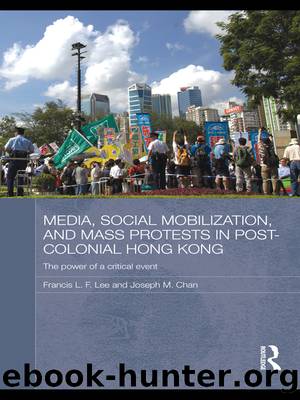
Author:Francis L. F. Lee, Joseph M. Chan [Francis L. F. Lee, Joseph M. Chan]
Language: eng
Format: epub
Tags: Social Science, Ethnic Studies, General, Sociology, Regional Studies
ISBN: 9781136860430
Google: SxStAgAAQBAJ
Publisher: Routledge
Published: 2010-12-23T03:39:19+00:00
Calling the sizes of protests
Size is an important aspect of any collective action. As sociologist Neil Smelser puts it, âTelling the size of a crowd is in the same category as uttering an effective slogan. As a measure of public sentiment, itâs not very precise. But as rhetoric and symbolism, it matters very muchâ (quoted in Herbst, 1993, p. 150). It matters particularly for social movement. As Tilly (2004) points out, a key aspect of any social movement is the public representations of the worthiness, unity, numbers, and commitment of its participants and/or constituents. All other things being equal, a large-scale protest is certainly more likely to be influential than a small protest. In Hong Kong, the July 1, 2003 protest would probably have had little impact on the national security legislation process if its size were much smaller.
As a result of its importance, crowd size often constitutes a subject of debate surrounding rallies and demonstrations (Herbst, 1993). State agents, such as the police, often give an estimation that is substantially lower than the estimates provided by the organizers of the collective action. Media with different political predilections tend to emphasize one figure over the other, while some media organizations may also provide their own estimations. Besides, other third parties, ranging from interested academics to local or foreign monitors, may also engage in crowd estimation and provide their own âindependentâ figures.
In this situation, although protest organizers have an incentive to overstate the number of protesters in order to emphasize peopleâs support for and commitment to the movement, they also need to be concerned with their own credibility in the public arena. If their estimation deviates too much from the independent estimations, their perceived trustworthiness may suffer.
Moreover, protest organizers also need to decide carefully how much emphasis they want to place on crowd size. Even in the case of a very successful large-scale protest, an over-emphasis on crowd size can have a few undesirable consequences. First, it might direct public and media attention away from the more substantive issues that the protest is supposed to address. Second, it might contribute to the idea that a protest without a large number of participants is meaningless. These two problems, when combined together, may come back to haunt the protest organizers in later protests. By calling media attention to crowd size, the size of a previous protest will become the yardstick the media use to evaluate the success or failure of future protests (e.g., Small, 1994). As protest sizes are not likely to remain extraordinarily high all the time, an over-emphasis on crowd size may only undermine the symbolic impact of a protest movement in the long run.
This was arguably what happened to the pro-democracy movement in Hong Kong between 2003 and 2007. After the July 1, 2003 protest, a sentiment widely shared by many pro-democracy politicians and activists was that the number of protesters on the day was far more than 500,000. When we asked Choi Yiu-cheong how the CHRF came up with the figure at the time, he acknowledged that 500,000 was only a very rough estimation.
Download
This site does not store any files on its server. We only index and link to content provided by other sites. Please contact the content providers to delete copyright contents if any and email us, we'll remove relevant links or contents immediately.
Spell It Out by David Crystal(36120)
Life for Me Ain't Been No Crystal Stair by Susan Sheehan(35813)
Cecilia; Or, Memoirs of an Heiress — Volume 1 by Fanny Burney(32562)
The Great Music City by Andrea Baker(32022)
Cecilia; Or, Memoirs of an Heiress — Volume 2 by Fanny Burney(31959)
Cecilia; Or, Memoirs of an Heiress — Volume 3 by Fanny Burney(31945)
Professional Troublemaker by Luvvie Ajayi Jones(29671)
The Secret History by Donna Tartt(19102)
We're Going to Need More Wine by Gabrielle Union(19052)
Twilight of the Idols With the Antichrist and Ecce Homo by Friedrich Nietzsche(18642)
All the Missing Girls by Megan Miranda(16048)
Cat's cradle by Kurt Vonnegut(15364)
Pimp by Iceberg Slim(14521)
For the Love of Europe by Rick Steves(14162)
Bombshells: Glamour Girls of a Lifetime by Sullivan Steve(14081)
Norse Mythology by Gaiman Neil(13376)
Talking to Strangers by Malcolm Gladwell(13376)
Fifty Shades Freed by E L James(13247)
The Social Justice Warrior Handbook by Lisa De Pasquale(12197)
